
India and ASEAN have relations "free from contests and claims" and believe in sovereign equality of all nations irrespective of size, and support for free and open pathways of commerce and engagement, Prime Minister Narendra Modi wrote in his column.

'The Indian strategy is to rope in the powerful Pakistan army in the negotiating spectrum. This can be done at the level of General Janjua, a former army commander,' reveals Rajeev Sharma.
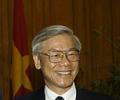
India-Vietnam relationship has its own imperatives and dynamism. In India's look east policy Vietnam has been the major pivot, at least in terms of security and strategic imperatives, says Rup Narayan Das.
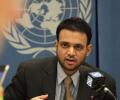
The 36-year-old desi speaks impeccable Arabic and quotes freely from the Quran during his speeches, reports Aziz Haniffa.

Against the backdrop of the standoff between Indian and Chinese troops in eastern Ladakh, the White House press secy said the United States was closely monitoring the current situation and supports its peaceful resolution.
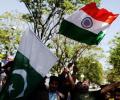
'The talks held in Bangkok, virtually on Indian terms, is an event where Pakistan seems to have blinked first.'

She says her priority areas would be military preparedness, defence indigenisation, and the welfare of soldiers.
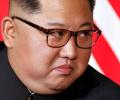
The visit, Kim's third since March, is taking place amid sharp escalation rhetoric between Beijing and Washington over tariffs almost spiralling into a trade war.
.jpg)
Climate change and US-India collaborations in renewable energy resources will be up for discussion at the US-India energy summit coinciding with Prime Minister Narendra Modi's visit to Washington, DC, later this month, reports Aziz Haniffa.

PM Modi articulated five action points that would serve the common interest of promoting peace and prosperity in the Indo-Pacific region.
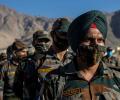
In a strong response to China's objection to development of infrastructure on the Indian side of the LAC, New Delhi also asserted that Beijing has no locus standi to comment on India's internal matters.
.jpg)
Kerry said this in a newspaper article co-authored by US Commerce Secretary Penny Pritzker.
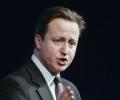
Britain's Prime Minister David Cameron on Sunday promised to "stand together" with Pakistan in the war against terrorism and nudged his counterpart Nawaz Sharif to help clinch a peace deal with Afghanistan before NATO's withdrawal from the war-torn nation next year.

'China any day would prefer to team up with India and dump Pakistan once the resolution of the border dispute becomes an accomplished fact.'

'An all-out war affects the whole nation.'
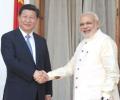
The summit is being seen as an effort by India and China to rebuild trust and improve ties that were hit by the 73-day-long Doklam standoff last year.

At the meeting of the 160-member World Trade Organisation in Geneva on Friday, India demanded a halt to the trade facilitation timetable till a permanent solution on public stockholding for food security is found.
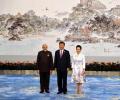
'By crudely dragging the topic into the bazaar to flog it for momentary pleasure, we turned it into a dead carcass by the time Modi even got back from Xiamen,' says Ambassador M K Bhadrakumar.
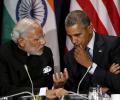
'Big countries do not agree on every set of issues.' 'Look, one of the differences in the relationship is that when we do not agree, we are sitting down and talking to each other.'

'The US wants Modi to succeed because we want India to succeed. For our part, when India thinks of its partners in the world, we want it to think of the US first. That means positioning our country as the preferred provider of the key inputs that can help to propel India's rise.' 'The meeting between Modi and Obama is, and must be, an opportunity for true strategic dialogue -- not a scripted exchange of talking points, but an open discussion of the big questions. What kind of world do we want to live in? What are our true priorities? And most importantly, why does this partnership still matter?'

'The government will ensure that India's pride is not affected as far as the situation along Indo-China border is concerned'
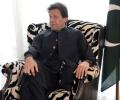
"The world's eye is on Kashmir and on Pakistan...I will be the ambassador who raises Kashmir's voice at every international forum," he said.

New Delhi and Beijing are the only two regional capitals that have commented on US President Donald Trump's speech on August 21 outlining the way forward in Afghanistan. The Indian foreign ministry statement was effusive in praise, while the Chinese statement has been one of cautious and guarded hope. Delhi has identified itself with Trump's Afghan strategy, whereas the Chinese stance is calibrated -- observant and objective, keeping a distance, says Ambassador M K Bhadrakumar.

'Chinese dominance reduces India's influence in South and Southeast Asia and erodes its status globally.' 'For a country striving to create a multipolar Asia, it would be a serious setback,' says Brigadier S K Chatterji (retd).
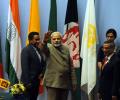
'If his three priorities are the economy, the economy, the economy, then there is need for a stable region, a stable neighbourhood.'

PM Modi seems to be gradually ending India's strategic ambiguity
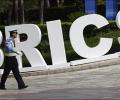
A feature of this year's BRICS summit was economic cooperation.

Prime Minister Narendra Modi's visit to South Korea is considered essential in strengthening defence ties, enhancing economic cooperation and forging cultural ties between the two countries, says Dr Rahul Mishra

The NASSCOM report said Indian tech industry contributed more than $375 million to the US Treasury between fiscal year 2011-2015
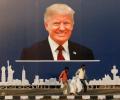
'It's the first-ever US presidential visit which is specially planned for India.' 'The standalone visit itself has achieved something already. Don't underestimate it.' Sheela Bhatt gives us an exclusive glimpse of what the Modi government hopes to achieve from Trump's visit.

Prime Minister Modi told President Xi that he has made efforts to improve ties with Islamabad but these efforts have been "derailed".

The joint statement issued after Prime Minister Narendra Modi and President Barack Obama's first-ever summit is high on intent and ambition. Notably missing from the statement is India's refusal to be America's partner in its war against ISIS.

'India-US defence pacts are seen by many analysts as a subtle move to jointly contain China's growing militarism, especially in the strategic Indian Ocean Region.'

With the Afghanistan government in Kabul approaching Islamabad for help in opening "reconciliation" talks with the Taliban, a Pakistani role in shaping the political landscape in Afghanistan is now an uncomfortable likelihood for New Delhi.
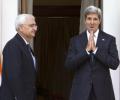
The United States on Monday assured India that its concerns over Taliban insurgents gaining legitimacy without severing their terror links will neither be "overlooked or undermined" during the talks with the Islamic fundamentalist group.

Talking about the Line of Actual Control, Defence Minister Nirmala Sitharaman said as it is not completely demarcated, there are differing perceptions about it by both sides.

Tillerson said China's behaviour and action is "posing a challenge to the rules-based international order".

India has sought access to Lashkar-e-Tayiba operative David Headley, the Mumbai terror attack convict now lodged in a US prison, as it insisted on bringing to justice the perpetrators of the 26/11 assault.

Both nations have to find ways to be sensitive to each other's politico-strategic and economic concerns, say Dr Rahul Mishra and Sana Hashmi.

During their talks, the two leaders decided to significantly expand their ties in several key areas including defence, trade, energy and education.
